MedOS Family MedMO
Open-source medical foundation model
MedMO
Grounding and understanding multimodal large language model for medical images
MedMO unifies visual grounding, clinical reasoning and language understanding across medical imaging modalities. It is trained only on medical data, 26M+ samples from 45 datasets, and released in 4B and 8B sizes.
At a glance
One model for medical images, questions, reports and localization
Result figures are for MedMO-8B-Next, as reported on the MedMO project page.
Why MedMO
Three limits of existing medical multimodal models
Multimodal large language models have advanced quickly, but their use in medicine is held back by limited domain coverage, imperfect alignment between modalities and too little grounded reasoning.
Reliance on distilled data
Most existing models are trained on data distilled from proprietary models, which often lacks the domain grounding needed for fine-grained clinical reasoning.
Hallucination risk
Distillation pipelines without structured supervision amplify hallucinations and inconsistencies in medical outputs.
Narrow modality coverage
Current models focus on single tasks or a few modalities instead of unified generalization across them.
Training
A four-stage training pipeline
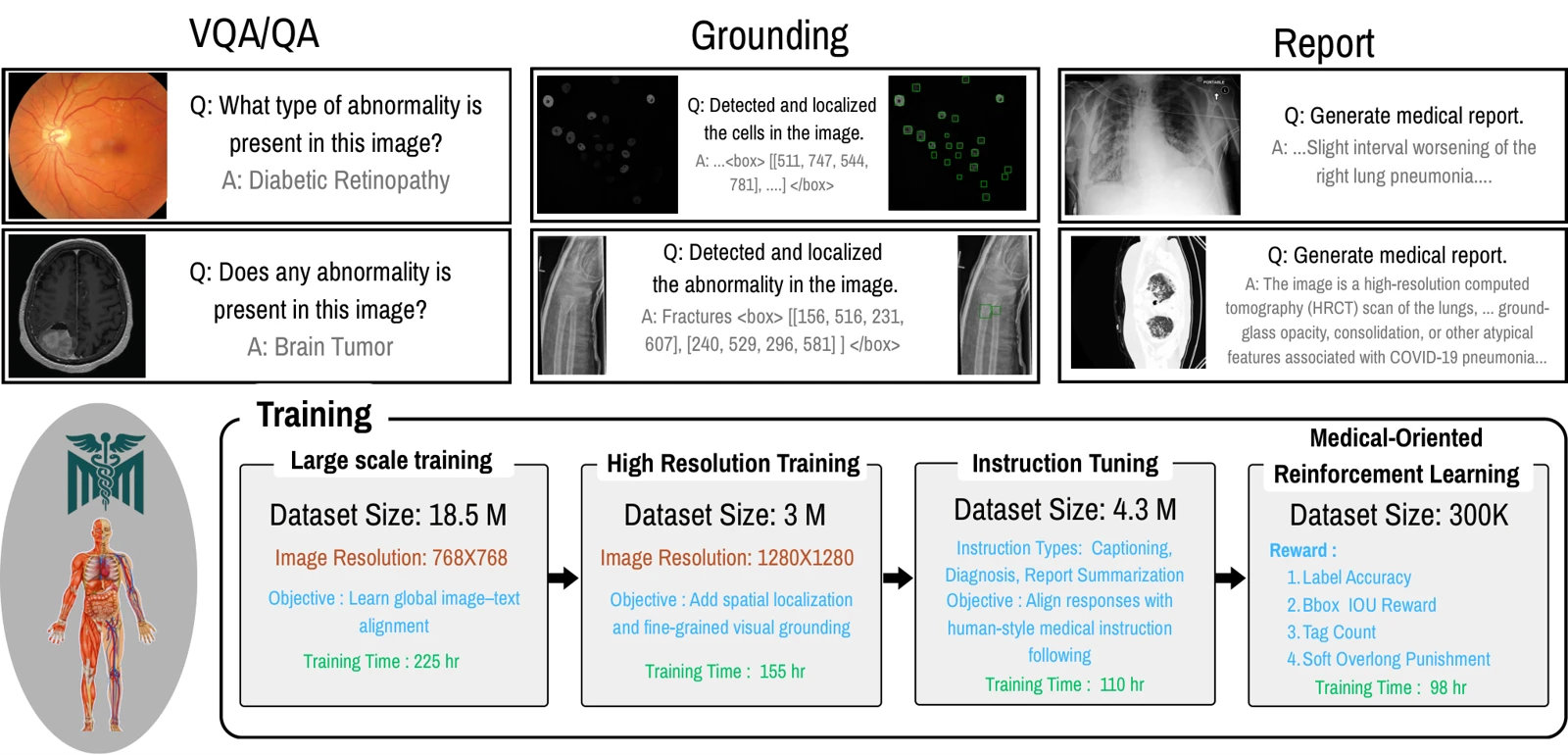
MedMO is built on Qwen3-VL and post-trained in four stages. Each stage adds a capability: broad medical understanding, high-resolution localization, instruction following, and reward-driven grounding.
- General medical SFTLarge-scale training for foundational understanding
- High-resolution SFTSpatial localization and fine-grained grounding
- Instruction tuningHuman-style medical instruction following
- Reinforcement learningGRPO with verifiable rewards
Where the training samples go
- Stage 1: General medical SFT 18.5M samples
- Stage 2: High-resolution SFT 3M samples
- Stage 3: Instruction tuning 4.3M samples
- Stage 4: Reinforcement learning 300K samples
26.1M samples across the four stages. Stage 4 is 1% of the samples.
Cross-modal pretraining
Heterogeneous visual encoders are aligned with a medical language backbone using a DeepStack fusion mechanism.
Multi-task supervision
Training spans captioning, VQA, report generation, retrieval and grounded disease localization with bounding boxes.
Verifiable rewards
A bounding-box GIoU reward is combined with factuality checks to improve spatial grounding and step-by-step reasoning.
Scalable architecture
The modular design on Qwen3-VL allows later expansion to additional modalities.
Results
Where MedMO-8B-Next gains over the previous best open model
Each row compares MedMO-8B-Next with Fleming-VL-8B on one benchmark, sorted by the size of the gain. Grounding improves the most.
- Fleming-VL-8B
- MedMO-8B-Next
Scores are accuracy in percent, or IoU in percent for grounding. Gains are differences in points.
Compare every model on every benchmark
Pick a task and a benchmark to rank all models reported for it.
- MedMO
- Other open-source models
- Proprietary models
Full results tables
VQA-RAD, SLAKE and Medbullets are reported in two variants for some models (closed/all, or 4 and 5 options), so they appear in the tables but not in the chart. MedMO rows are highlighted. A dash means not reported.
Medical VQA: full table (accuracy, %)
| Model | MMMU-Med | VQA-RAD (closed/all) | SLAKE (closed/all) | PathVQA (all) | PMC-VQA | OMVQA | MedXQA | Avg. |
|---|---|---|---|---|---|---|---|---|
| GPT-4.1 | 75.2 | 65.0 | 72.2 | 55.5 | 55.2 | 75.5 | 45.2 | 63.4 |
| Claude Sonnet 4 | 74.6 | 67.6 | 70.6 | 54.2 | 54.4 | 65.5 | 43.3 | 61.5 |
| Gemini-2.5-Flash | 76.9 | 68.5 | 75.8 | 55.4 | 55.4 | 71.0 | 52.8 | 65.1 |
| BiomedGPT | 24.9 | 16.6 | 13.6 | 11.3 | 27.6 | 27.9 | – | – |
| Med-R1-2B | 34.8 | 39.0 | 54.5 | 15.3 | 47.4 | – | 21.1 | – |
| MedVLM-R1-2B | 35.2 | 48.6 | 56.0 | 32.5 | 47.6 | 77.7 | 20.4 | 45.4 |
| MedGemma-4B-IT | 43.7 | 72.5 | 76.4 | 48.8 | 49.9 | 69.8 | 22.3 | 54.8 |
| LLaVA-Med-7B | 29.3 | 53.7 | 48.0 | 38.8 | 30.5 | 44.3 | 20.3 | 37.8 |
| HuatuoGPT-V-7B | 47.3 | 67.0 | 67.8 | 48.0 | 53.3 | 74.2 | 21.6 | 54.2 |
| BioMediX2-8B | 39.8 | 49.2 | 57.7 | 37.0 | 43.5 | 63.3 | 21.8 | 44.6 |
| Qwen2.5VL-7B | 50.6 | 64.5 | 67.2 | 44.1 | 51.9 | 63.6 | 22.3 | 52.0 |
| InternVL2.5-8B | 53.5 | 59.4 | 69.0 | 42.1 | 51.3 | 81.3 | 21.7 | 54.0 |
| InternVL3-8B | 59.2 | 76.4/52.9 | 72.1/62.4 | 39.0 | 53.8 | 79.1 | 22.4 | 57.4 |
| Lingshu-7B | 54.0 | 77.2/43.0 | 82.4/33.2 | 41.9 | 54.2 | 82.9 | 26.9 | 55.1 |
| Fleming-VL-8B | 63.3 | 78.4/56.4 | 86.9/80.0 | 56.5 | 64.3 | 88.2 | 21.6 | 66.1 |
| Qwen3VL-8B (base model) | 61.4 | 54.1/31.2 | 34.3/15.0 | 14.6 | 52.3 | 77.2 | 24.8 | 40.5 |
| MedMO-4B | 54.6 | 50.9/35.0 | 41.0/30.0 | 42.4 | 50.6 | 79.7 | 24.8 | 45.4 |
| MedMO-4B-Next | 58.7 | 79.7/59.6 | 78.0/74.0 | 73.3 | 75.7 | 90.6 | 27.0 | 68.5 |
| MedMO-8B | 64.6 | 72.3/64.7 | 70.6/70.0 | 56.3 | 59.4 | 84.8 | 26.2 | 63.2 |
| MedMO-8B-Next | 69.3 | 86.4/68.0 | 83.0/81.6 | 56.3 | 74.1 | 93.3 | 42.9 | 72.7 |
Text QA: full table (accuracy, %)
| Model | MMLU-Med | PubMedQA | MedMCQA | MedQA | Medbullets (op4/op5) | MedXQA | SGPQA | Avg. |
|---|---|---|---|---|---|---|---|---|
| GPT-4.1 | 89.6 | 75.6 | 77.7 | 89.1 | 77.0 | 30.9 | 49.9 | 70.0 |
| Claude Sonnet 4 | 91.3 | 78.6 | 79.3 | 92.1 | 80.2 | 33.6 | 56.3 | 73.1 |
| Gemini-2.5-Flash | 84.2 | 73.8 | 73.6 | 91.2 | 77.6 | 35.6 | 53.3 | 69.9 |
| BiomedGPT | – | – | – | – | – | – | – | – |
| Med-R1-2B | 51.5 | 66.2 | 39.1 | 39.9 | 33.6 | 11.2 | 17.9 | 37.0 |
| MedVLM-R1-2B | 51.8 | 66.4 | 39.7 | 42.3 | 33.8 | 11.8 | 19.1 | 37.8 |
| MedGemma-4B-IT | 66.7 | 72.2 | 52.2 | 56.2 | 45.6 | 12.8 | 21.6 | 46.8 |
| LLaVA-Med-7B | 50.6 | 26.4 | 39.4 | 42.0 | 34.4 | 9.9 | 16.1 | 31.3 |
| HuatuoGPT-V-7B | 69.3 | 72.8 | 51.2 | 52.9 | 40.9 | 10.1 | 21.9 | 45.6 |
| BioMediX2-8B | 68.6 | 75.2 | 52.9 | 58.9 | 45.9 | 13.4 | 25.2 | 48.6 |
| Qwen2.5VL-7B | 73.4 | 76.4 | 52.6 | 57.3 | 42.1 | 12.8 | 26.3 | 48.7 |
| InternVL2.5-8B | 74.2 | 76.4 | 52.4 | 53.7 | 42.4 | 11.6 | 26.1 | 48.1 |
| InternVL3-8B | 77.5 | 75.4 | 57.7 | 62.1 | 50.2/42.8 | 13.1 | 31.2 | 51.2 |
| Lingshu-7B | 69.6 | 75.8 | 56.3 | 63.5 | 62.0/53.8 | 16.4 | 27.5 | 53.1 |
| Fleming-VL-8B | 71.8 | 74.0 | 51.8 | 53.7 | 40.5/37.3 | 12.1 | 24.9 | 45.7 |
| Qwen3VL-8B (base model) | 79.3 | 70.4 | 60.0 | 66.1 | 56.1/47.7 | 15.1 | 34.7 | 53.6 |
| MedMO-4B | 75.7 | 78.0 | 58.0 | 78.5 | 57.5/47.7 | 16.4 | 29.4 | 55.1 |
| MedMO-4B-Next | 74.8 | 78.2 | 58.1 | 78.3 | 57.4/47.6 | 16.5 | 29.5 | 55.0 |
| MedMO-8B | 81.0 | 77.6 | 65.0 | 84.3 | 66.5/60.2 | 19.9 | 36.0 | 61.3 |
| MedMO-8B-Next | 80.2 | 75.6 | 62.0 | 83.8 | 65.2/57.8 | 20.9 | 35.5 | 60.1 |
Report generation: full table
| Model | MIMIC-CXR | CheXpert Plus | IU-Xray | Med-Trinity | ||||||||||||
|---|---|---|---|---|---|---|---|---|---|---|---|---|---|---|---|---|
| R-L | CIDEr | RaTE | Semb | R-L | CIDEr | RaTE | Semb | R-L | CIDEr | RaTE | Semb | R-L | CIDEr | RaTE | Semb | |
| GPT-4.1 | 9.0 | 82.8 | 51.3 | 23.9 | 24.5 | 78.8 | 45.5 | 23.2 | 30.2 | 124.6 | 51.3 | 47.5 | – | – | – | – |
| Claude Sonnet 4 | 20.0 | 56.6 | 45.6 | 19.7 | 22.0 | 59.5 | 43.5 | 18.9 | 25.4 | 88.3 | 55.4 | 41.0 | – | – | – | – |
| Gemini-2.5-Flash | 25.4 | 80.7 | 50.3 | 29.7 | 23.6 | 72.2 | 44.3 | 27.4 | 33.5 | 129.3 | 55.6 | 50.9 | – | – | – | – |
| Med-R1-2B | 19.3 | 35.4 | 40.6 | 14.8 | 18.6 | 37.1 | 38.5 | 17.8 | 16.1 | 38.3 | 41.4 | 12.5 | – | – | – | – |
| MedVLM-R1-2B | 20.3 | 40.1 | 41.6 | 14.2 | 20.9 | 43.5 | 38.9 | 15.5 | 22.7 | 61.1 | 46.1 | 22.7 | – | – | – | – |
| MedGemma-4B-IT | 25.6 | 81.0 | 52.4 | 29.2 | 27.1 | 79.0 | 47.2 | 29.3 | 30.8 | 103.6 | 57.0 | 46.8 | – | – | – | – |
| LLaVA-Med-7B | 15.0 | 43.4 | 12.8 | 18.3 | 18.4 | 45.5 | 38.8 | 23.5 | 18.8 | 68.2 | 40.9 | 16.0 | – | – | – | – |
| HuatuoGPT-V-7B | 23.4 | 69.5 | 48.9 | 20.0 | 21.3 | 64.7 | 44.2 | 19.3 | 29.6 | 104.3 | 52.9 | 40.7 | – | – | – | – |
| BioMediX2-8B | 20.0 | 52.8 | 44.4 | 17.7 | 18.1 | 47.9 | 40.8 | 21.6 | 19.6 | 58.8 | 40.1 | 11.6 | – | – | – | – |
| Qwen2.5VL-7B | 24.1 | 63.7 | 47.0 | 18.4 | 22.2 | 62.0 | 41.0 | 17.2 | 26.5 | 78.1 | 48.4 | 36.3 | 23.5 | 81.5 | 44.9 | 38.3 |
| InternVL2.5-8B | 23.2 | 61.8 | 47.0 | 21.0 | 20.6 | 58.5 | 43.1 | 19.7 | 24.8 | 75.4 | 51.1 | 36.7 | 13.5 | 47.1 | 42.5 | 12.8 |
| InternVL3-8B | 22.9 | 66.2 | 48.2 | 21.5 | 20.9 | 65.4 | 44.3 | 25.2 | 22.9 | 76.2 | 51.2 | 31.3 | 12.9 | 46.6 | 42.2 | 3.7 |
| Lingshu-7B | 30.8 | 109.4 | 52.1 | 30.0 | 26.5 | 79.0 | 45.4 | 26.8 | 41.2 | 180.7 | 57.6 | 48.4 | 16.0 | 74.5 | 44.4 | 24.0 |
| Fleming-VL-8B | 35.7 | 132.5 | 56.7 | 33.6 | 26.1 | 82.2 | 47.1 | 40.1 | 44.9 | 198.6 | 66.0 | 51.3 | 13.1 | 35.8 | 41.9 | 18.1 |
| Qwen3VL-8B (base model) | 25.1 | 77.9 | 50.3 | 33.4 | 21.9 | 67.4 | 44.4 | 37.9 | 25.0 | 91.44 | 52.5 | 42.9 | 20.2 | 69.9 | 45.9 | 33.6 |
| MedMO-4B | 26.0 | 92.6 | 49.8 | 31.6 | 15.1 | 62.3 | 36.6 | 34.2 | 26.6 | 94.0 | 42.1 | 41.3 | 22.5 | 152.6 | 47.8 | 34.3 |
| MedMO-4B-Next | 28.3 | 96.7 | 52.0 | 34.3 | 23.5 | 74.5 | 42.6 | 38.7 | 38.0 | 147.8 | 62.0 | 49.4 | 26.3 | 183.8 | 49.5 | 38.6 |
| MedMO-8B | 31.7 | 140.0 | 57.1 | 50.0 | 23.6 | 87.5 | 47.3 | 42.2 | 31.1 | 169.7 | 45.3 | 41.3 | 37.0 | 270.4 | 53.0 | 39.2 |
| MedMO-8B-Next | 32.6 | 143.4 | 57.7 | 51.5 | 25.7 | 88.3 | 48.1 | 43.8 | 31.8 | 171.9 | 56.0 | 43.1 | 38.5 | 272.1 | 53.8 | 40.7 |
Grounding: full table (IoU, %)
| Model | NIH | DeepLesion | Bacteria | MedSG (multi_view) | MedSG (object_tracking) | MedSG (referring) | Avg. |
|---|---|---|---|---|---|---|---|
| InternVL3-8B | 10.1 | 0.00 | 0.7 | 6.3 | 13.0 | 3.3 | 5.6 |
| Fleming-VL-8B | 0.00 | 0.00 | 8.3 | 42.0 | 36.7 | 16.6 | 17.2 |
| Lingshu-7B | 5.3 | 0.7 | 10.8 | 28.3 | 38.7 | 10.4 | 13.9 |
| Qwen3VL-8B | 16.4 | 0.00 | 9.16 | 8.4 | 17.8 | 31.4 | 13.8 |
| MedSG-Bench | – | – | – | 55.0 | 62.1 | 60.4 | – |
| MedMO-8B | 8.83 | 38.5 | 54.6 | 75.8 | 77.2 | 70.1 | 54.2 |
| MedMO-8B-Next | 15.9 | 40.5 | 56.1 | 77.5 | 78.8 | 71.9 | 56.8 |
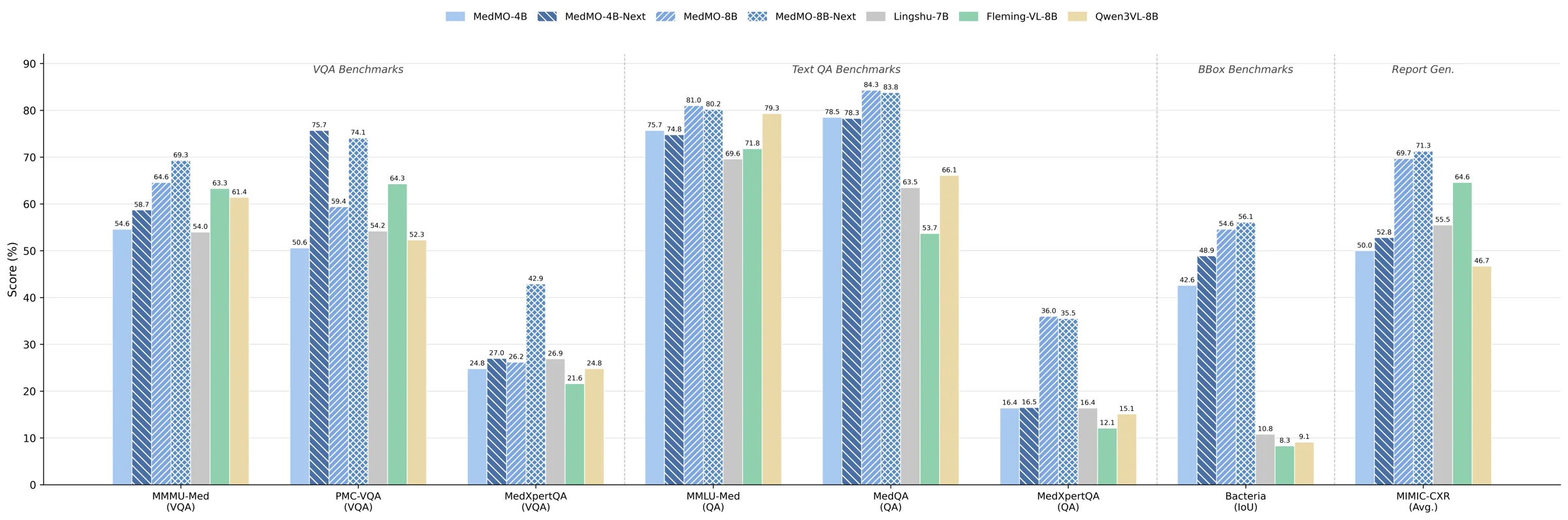
For report generation, MedMO-8B-Next reaches CIDEr 143.4 on MIMIC-CXR (Fleming-VL-8B: 132.5) and CIDEr 272.1 on Med-Trinity, where the next best open-source model reaches 81.5. MedMO-4B-Next exceeds Fleming-VL-8B on average medical VQA and text QA at half the size.
Grounding example
Finding one cell in a microscopy image
Asked to detect and localize all cells in an image, MedMO returns a box on the cell. The two compared models return boxes covering almost the whole image.
| Source | Predicted box |
|---|---|
| Ground truth | [54, 545, 63, 554] |
| MedMO | [53, 548, 62, 557] |
| Fleming-VL | [0, 0, 999, 999] |
| Qwen3-VL | [31, 21, 965, 957] |
Coordinates as listed on the project page, drawn here as schematic boxes without the microscopy image. Each MedMO coordinate is within 3 grid units of the ground truth.
Data
A unified multimodal medical dataset
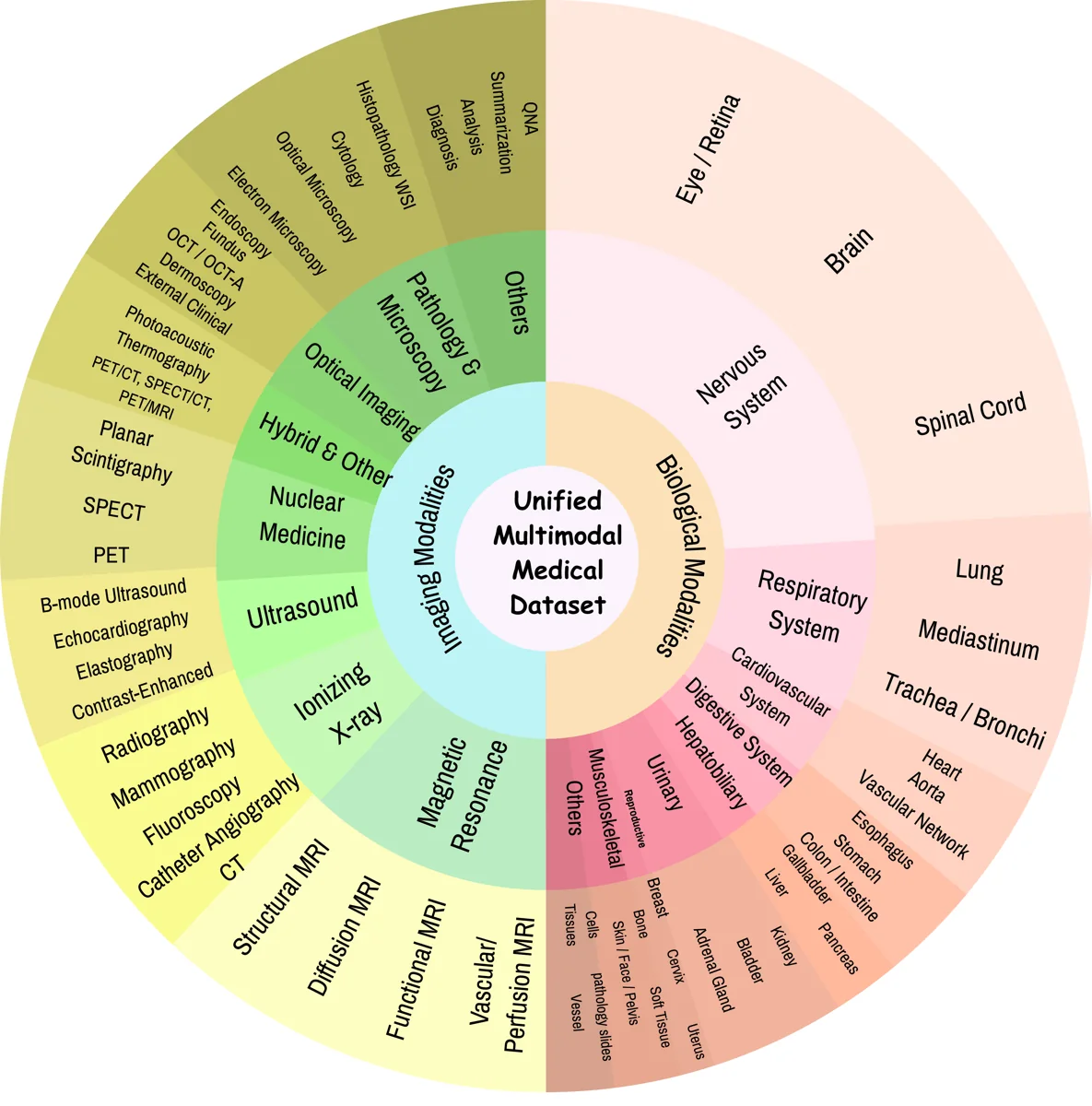
The training data brings together 26M+ samples from 45 medical datasets, covering both how an image was acquired and which part of the body it shows.
Imaging modalities
X-rayCTMRIUltrasoundNuclear medicineOptical imagingPathology and microscopy
Biological systems
NervousRespiratoryCardiovascularDigestiveHepatobiliaryUrinaryReproductiveMusculoskeletal
Tasks
CaptioningVisual question answeringReport generationRetrievalBounding-box disease localization
Contributions
What MedMO contributes
Open-source foundation model
A post-trained multimodal vision-language model for medical image understanding and grounding, available in 4B and 8B variants.
Scalable training pipeline
26M+ multimodal medical samples curated from 45 datasets, with multi-stage post-training that progressively improves cross-modal alignment.
New evaluation benchmark
A dedicated Cell dataset built from open-source microscopy images with varying sizes, shapes and densities, for evaluating detection.
Comprehensive analysis
Experiments across data and methodology, providing an open benchmark for future multimodal medical LLM research.
Open source
Get the model
Models on Hugging FaceCode and usage guideRead the paperProject page
Available checkpoints
MedMO-4B · MedMO-8B · full collection
See the model cards for checkpoint-specific requirements, licensing and usage instructions. MedMO is part of the MedOS Family. A qualitative example from the paper: view a published result.

Cite
@article{deria2026medmo,
  title   = {MedMO: Grounding and Understanding Multimodal Large Language Model for Medical Images},
  author  = {Deria, Ankan and Kumar, Komal and Dukre, Adinath Madhavrao and Segal, Eran and Khan, Salman and Razzak, Imran},
  journal = {arXiv preprint arXiv:2602.06965},
  year    = {2026}
}