DoAtlas Family

Causal AI for medicine

From executable evidence to autonomous discovery

DoAtlas is our line of research on causal AI for medicine and biomedical science. The aim is AI whose claims rest on explicit causal structure that can be queried, checked against real human data, and revised when the evidence changes, in place of answers that cannot be audited.

The models

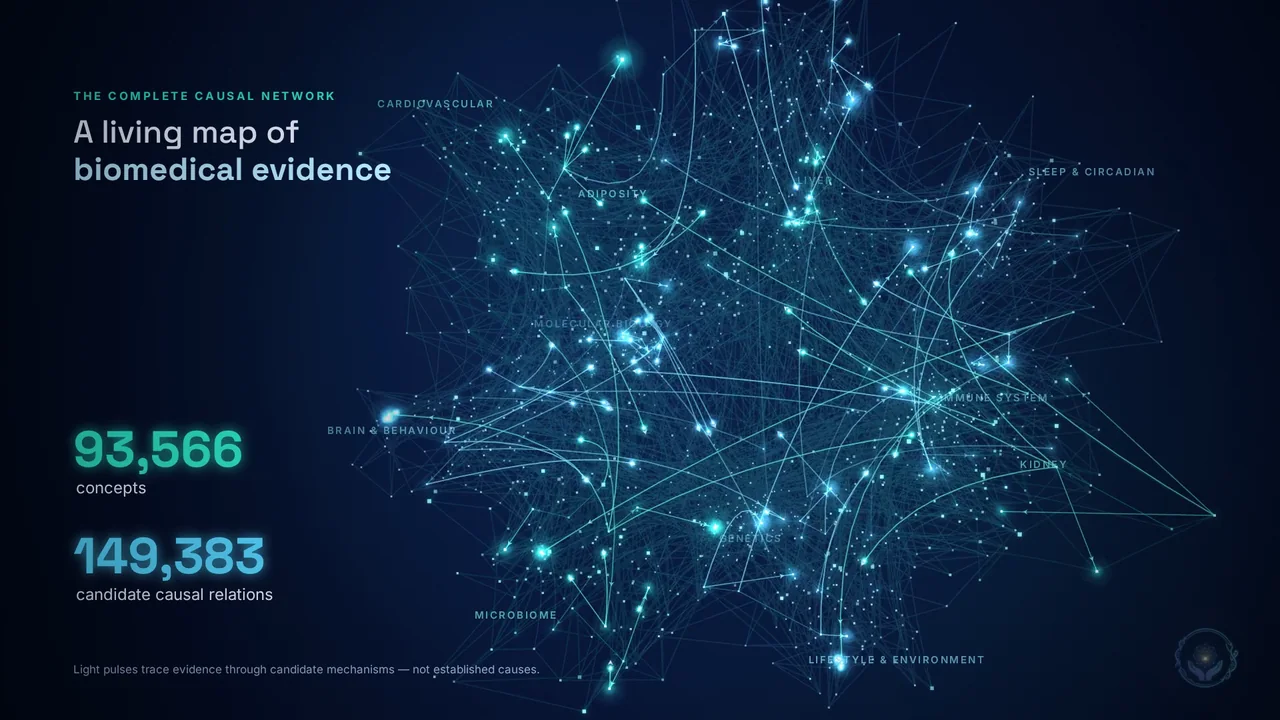
Still from the DoAtlas-2 explainer: a network map of biomedical evidence with 93,566 concepts and 149,383 candidate causal relations

DoAtlas-2 New

A causal world model for autonomous scientific discovery · September 2026

DoAtlas-2 runs the full research cycle on its own. It formulates research questions from gaps and conflicts in the evidence, freezes each study design before outcomes are revealed, tests it in real human data, and lets supporting, challenging and unresolved results decide what it studies next.

Built on 771 research resources covering more than 720,000 participants in 48 countries, with 93,566 concepts and 149,383 candidate causal relationships. So far it has evaluated 2,031 research questions end to end.

Overview figure from the DoAtlas-1 paper

DoAtlas-1

A causal compilation paradigm for clinical AI · February 2026

DoAtlas-1 introduced causal compilation: converting medical evidence from narrative text into executable code. Findings are standardized into estimand objects that state the intervention contrast, effect scale, time horizon and target population, and support six kinds of executable causal query, including do-calculus, counterfactuals and joint interventions.

It compiles 1,445 effect kernels from 754 studies and validates them against Human Phenotype Project data, reaching 98.5% canonicalization accuracy and 80.5% query executability.

How the two relate

DoAtlas-1DoAtlas-2
Question it answersWhat does the existing evidence say, in a form that can be executed and audited?Which hypotheses are true, and what should be studied next?
Core ideaCausal compilation of published findings into executable estimand objectsA closed loop of hypothesis generation, prespecified testing in human data, and evidence-driven revision
Scale1,445 effect kernels from 754 studies93,566 concepts, 149,383 candidate causal relationships, 2,031 research questions evaluated
Grounding in human dataValidation against the Human Phenotype Project771 research resources, more than 720,000 participants, with the Human Phenotype Project as the core longitudinal cohort
OutputExecutable, auditable causal queriesAn evolving causal evidence state and a fully interpretable predictive model
AvailabilityPaperTechnical report; open-source release coming soon

Open source

DoAtlas will be open source and available to researchers soon. The first release includes 1,000 research questions with 30,000 corresponding experimental results. See the DoAtlas-2 release status for what is available today, and how DoAtlas-2 supports research.